Why Storytelling Builds Children's Capacity to Overcome Adversity
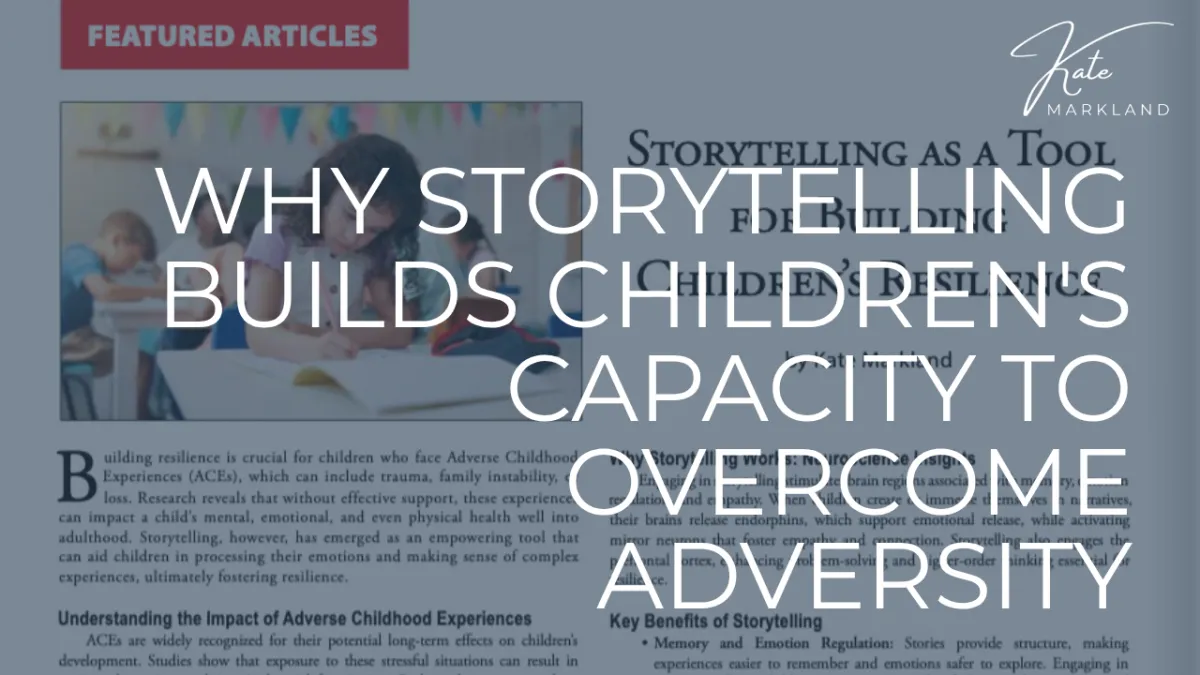
When Canadian Teacher Magazine published "Storytelling as a Tool for Building Children's Resilience" in their peer-reviewed journal, they did something important. They explained not just that storytelling works for trauma-affected children, but why.
The article opens with a fact that should concern every school leader: one in five children experiences Adverse Childhood Experiences, trauma, family instability, or loss that can affect mental, emotional, and physical health well into adulthood. Children with ACEs history often present in classrooms as withdrawn, anxious, or reactive to stress. They need support now, not after a two-year therapy waiting list.
What Canadian Teacher Magazine sets out is the neuroscience of why storytelling provides that support. When children create or engage with narratives, their brains release endorphins that support emotional release and stress reduction, activate mirror neurons that build empathy and connection, and engage the prefrontal cortex in ways that strengthen problem-solving and self-regulation. This is not metaphorical. It is measurable neural activity.
The journal identifies four specific benefits. Stories give chaotic experiences a structure, making difficult emotions safer to explore at a distance. Characters give children a way to practise perspective-taking and empathy without exposure. When children create heroes who face adversity and find a way through, they build internal narratives about their own capability, and the brain does not fully distinguish between imagined success and actual success. Both build the neural pathways associated with confidence and agency. Finally, the act of articulating a story, sequencing events, identifying cause and effect, strengthens the executive function that underpins planning and self-regulation across every area of life.
Every one of these mechanisms is what we see in StoryQuest sessions. Children narrating stories aloud while a partner scribes. No blank page, no spelling pressure, just imagination moving freely. Complete creative autonomy: the child chooses the plot, the characters, the outcome. Pairs building each other's stories rather than competing. The Golden Question at the end: "What was it like to be the author of your own story?"
Tom Hirst at Dixon's Manningham put it plainly: "They were lifting each other's stories. That's not just literacy. That's emotional intelligence." Canadian Teacher Magazine's peer-reviewed research explains exactly why that is true at a neurological level.
Across 465 children in 9 UK schools, we have documented 100% engagement, zero behavioural incidents, and consistent identity shifts from "I can't write" to "I want to be an author." The neuroscience Canadian Teacher Magazine cites is not theoretical for us. It is what UK teachers have been watching happen in their classrooms.


